So having decided that I wasn't likely to be adding the vegan cookies I made last time to my regular rotation, I found myself baking some thank you cookies for a vegan friend, so had to make another batch! It was supposed to be the same recipe as last time except for reducing the amount of chocolate chips to 185g, but clearly I did something different, as the cookies came out much less flat and a bit more cookie-like. I think last time I must have used a bit less flour/more fat - but even though they look rather different this time around, the texture's surprisingly not that different.
Sunday, 20 September 2020
Friday, 28 August 2020
Vegan cookies
To me, vegan baking is really, really hard - eggs are just a magic ingredient. They bind mixtures, give structure, stop things from drying out too much - they're by far the hardest thnig to substitute out successfully. It's the last week of the lockdown baking group that I've been (occasionally) participating in, and so I'm going to give it a shot - this is actually from last week's choice, but I meant to do it and didn't manage to get around to it, so there you go. It's this recipe, essentially unchanged.
Vegan Chocolate Chip Cookies
Ingredients
- 125g Coconut oil
- 100g Caster sugar
- 150g Soft dark brown sugar
- 125g Coconut milk
- 1tsp Vanilla extract
- 275g Plain flour
- 1tsp Baking powder
- 1/4tsp Bicarbonate of soda
- 200g Chocolate chips
Method
- Mix the coconut oil and sugars together.
- Beat in the coconut milk and vanilla.
- Stir in the flour, baking powder and bicarbonate of soda to form a thick batter.
- Stir in the chocolate chips.
- Cover and refrigerate for at least 1 hour.
- Form into plum sized balls and bake for 12-15 minutes at 180C.
- Allow to cool slightly before removing to a wire rack.
Tuesday, 11 August 2020
Advances in automation
As of this weekend, I now have a breadmaker (thanks Paul!). Obviously baking bread in a breadmaker doesn't count as "baking" for the purposes of going on the blog, but I tried it out for the first time today, and thought that at least was worth a note.
So how was it? Well I followed the basic white bread recipe in the manual and... well... it's not great. It's not terrible either, and certainly for the 5 minutes or so of active time that this required, it's really pretty darned good, but discounting the ease of it all and judging solely on the quality of the output, it's not great. It's a bit dense, a bit close and most definitely too sweet. The latter part should be easy enough to fix I'd imagine, but the texture seems a lot like an under developed gluten structure, which might mean that the dough doesn't get kneaded sufficiently in the machine. I'll definitely have to have a play around with it to see if I can do better, but it's also nice to see that I'm not that easily replaced by a machine :o).

Wednesday, 5 August 2020
Baking for fuel
- 150g Butter
- 200g Oats and seeds*
- 115g Caster sugar
- 170g Dried cranberries
- Melt the butter.
- Mix in all the other ingredients.
- Press into a lined tin and bake at 180C for 20 minutes.
- Leave to cool slightly before removing from tin.
Sunday, 2 August 2020
A Danish dream
- 3 Eggs
- 250g Caster sugar
- 1tsp Vanilla extract
- 50g Butter
- 200ml Milk
- 250g Plain flour
- 2tsp Baking powder
- 125g Butter
- 50ml Milk
- 160g Dark soft brown sugar
- 40g Caster sugar*
- 100g Dessicated coconut
- Whisk the eggs, caster sugar and vanilla extract until light and fluffy.
- Melt the butter (for the cake).
- Stir in the melted butter and milk (for the cake).
- Stir in the flour and baking powder until smooth.
- Pour into a lined tin and bake at 200C for ~25 mins.
- Heat the butter, milk and sugar for the topping in a saucepan and simmer for ~1 min.
- Stir in the dessicated coconut.
- Spread the topping over the cake and bake for a further 10 mins.
- Remove to a wire rack to cool.

Sunday, 26 July 2020
Belated brownies
- 225g Butter
- 350g Dark chocolate
- 4 Eggs
- 350g Dark soft brown sugar
- 1tsp Vanilla extract
- 200g Pecans
- 225g Plain flour
- Melt butter and chocolate together.
- Whisk eggs, sugar and vanilla in a stand mixer until pale and fluffy.
- Stir butter/chocolate into egg mixture.
- Coarsely chop pecans.
- Fold pecans and flour into mixture.
- Pour into a lined tin and bake at 180C for ~30 mins.
- Leave to cool (a bit!) before cutting.
Saturday, 18 July 2020
Marzipan truffles
- 300ml Double cream
- 550g Dark chocolate chips
- 450g Marzipan
- 400g Dark chocolate chips
- Chopped almonds
- 30g Icing sugar
- 15g Cocoa powder
- Make a ganache by scalding the cream and pour over the chocolate for the filling, and stir to melt the chocolate.
- Look on in minor horror as the realisation of quite how much ganache you've just made hits you.
- Refrigerate ganache overnight to set.
- Shape the ganache into small marble-sized balls.
- Roll out the marzipan and wrap around the ganache balls until it runs out.
- Melt the chocolate and dip the truffles.
- Roll them in the chopped almonds and set on a sheet of baking parchment.
- When bored of dipping truffles, mix the icing sugar and cocoa powder, and roll the remaining truffles in the powder.
- Refrigerate to set.
Saturday, 9 May 2020
Lockdown loaf take two
Lockdown Loaf Take Two
Ingredients
100g Aage
750g Strong white flour
400g Water
13g Salt
Method
- Mix Aage, 100ml flour and water together, cover and leave in a warm place for ~3 hours. (12pm)
- Mix 500g of the flour with 300ml water in a separate bowl, mix, cover and leave for a further two and a half hours. (3pm)
- Combine the mixtures from steps 1 and 2 with the salt and knead with the dough hook attachment of a stand mixer for ~10 minutes (I'm feeling lazy, okay?). (5:30pm)
- Cover and leave to rise for ~four and a half hours.
- Realise that your dough is closer to liquid than solid and panic a bit. Add a further 150g flour and knead - first in the stand mixer, then by hand. (10pm)
- Cover and place in fridge to prove overnight.
- Preheat oven to max with Dutch oven inside. (9am)
- Pour* dough out onto baking parchment and transfer to Dutch oven.
- Bake at 220C for 20 minutes.
- Uncover and bake at 180C for a further 30 minutes.
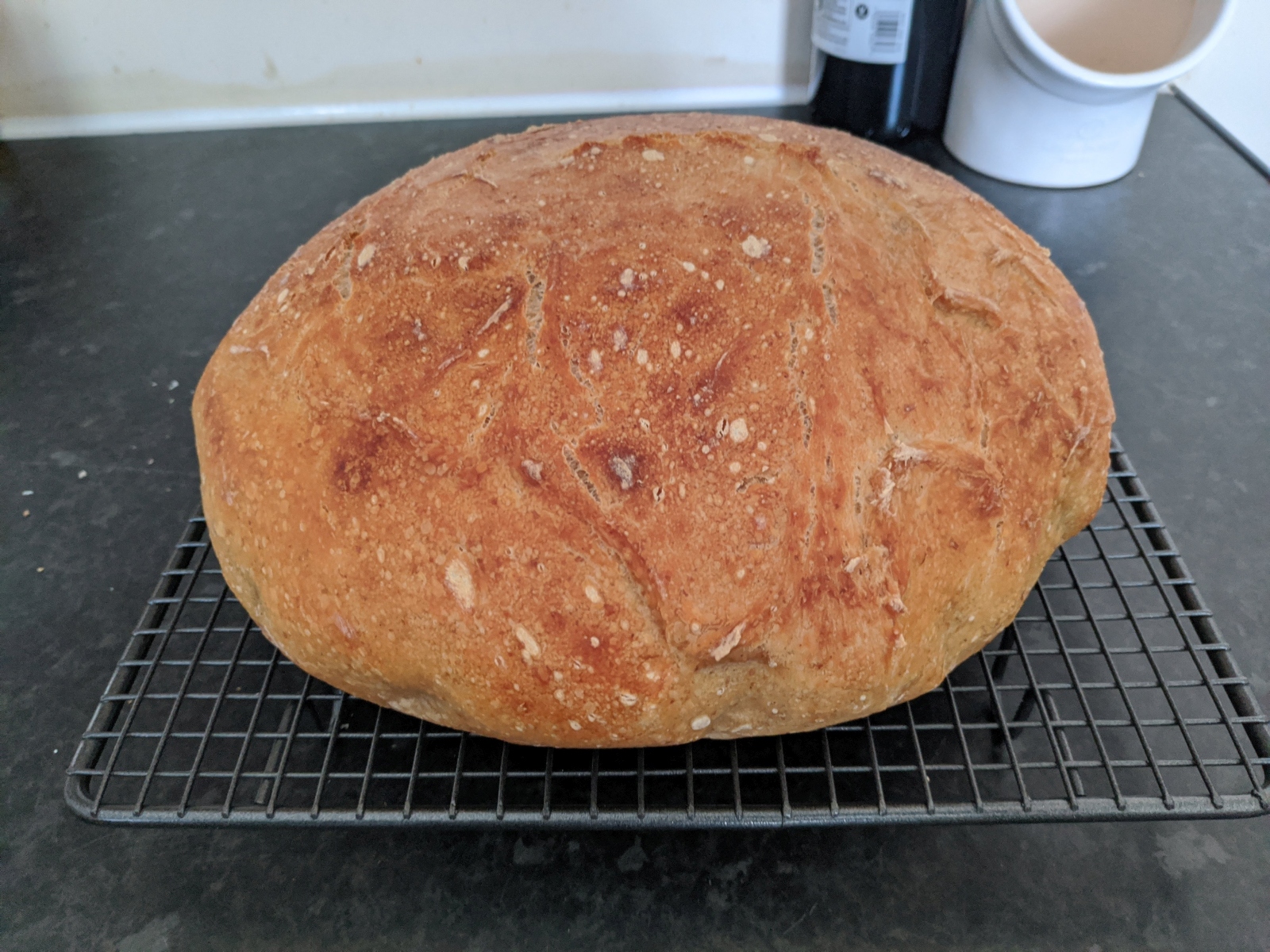
But look at the result! Don't try to tell me that that's not a beautiful loaf!
And how is it on the inside, I hear you ask. Well, not my best ever loaf, but not bad overall! I need to learn to keep my nerve and give it longer in the oven - it's a bit doughy and stodgy in the middle still, which I'm pretty sure another 15 minutes would have sorted out. But the crust has a lovely texture, the rise is actually not bad and the texture is lovely and elastic. A little more drying out and this would have been really lovely. As it is, it's just really good!
Saturday, 28 March 2020
Lockdown loaf
Lockdown Loaf
Ingredients
- 160g Aage
- 250g Strong wholemeal flour
- 250g Strong white flour
- 320g Water
- 10g Salt
- Mix all ingredients together and form dough.
- Knead until bored.
- Cover and leave to rise for ~2hrs.
- Knead and shape into loaf.
- Place on parchment paper and leave to proof overnight.
- Preheat oven to 220C with Dutch oven inside.
- Place dough in Dutch oven and lightly sprinkle with water.
- Bake at 220C for 20mins.
- Remove lid of Dutch oven and turn oven down to 200C for a further ~25mins.
Not a bad rise, all things considered. I had completely forgot to score the bread before chucking it into the oven, so perhaps it could have risen a little bit more - though given the general liquidness and lack of structure to the dough, I'm not sure how of a difference this would actually have made. The crust is a bit darker than I'd have liked, but it's not actually burnt at all, and it's got quite a pleasing colour to it. I suspect it might be a bit hard and a bit thick, but I've got to say, it's still quite an attractive looking loaf!
First, the bad: as expected, it's a flawed loaf - it's got the huge balloon of air at the top, which I suspect might be over-proofing at play. The thin skin left at the very top explains why it went so dark so quickly, and that in turn led me to underbake it - the inside is a bit overly doughy and excessively moist, and the crust could, if anything, do with being slightly thicker. But actually, despite the flaws, this loaf is quite wonderful still! The flavour is beautiful - complex and sour enough that you don't feel cheated of it being a sourdough, but not overpoweringly so. The crust has a lovely snap in the bits where it was sufficiently cooked - on the very thin top and the base (a side effect of the Dutch oven is that the bottom crust is thickened). All in all, it's a joy to eat, even if the flaws are glaringly obvious!
Sunday, 22 December 2019
It's my party and I'll bake if I want to
Sunday, 1 September 2019
Vanquishing foes
Doughnuts
Ingredients
- 1 Egg
- 90ml Water
- 150g Buttermilk
- 60g Butter
- 60g Caster sugar
- 450g Plain flour
- 1 sachet (7g) Fast action dried yeast
- Caster sugar for coating
- Ground cinnamon for coating
- Put all of the ingredients (except for the coatings) in a stand mixer with a dough hook and mix until a dough forms. Continue to mix for ~5 mins.
- Place bowl in a bin bag and leave to rise for ~1hr.
- Knead briefly. Shape into doughnut shapes and place on parchment.
- Leave to rise in an (off) oven, with a tray of boiling water underneath.
- Heat sunflower oil to ~180C.
- Fry each doughnut until golden brown underneath, then flip and fry other side.
- Allow to cool slightly on kitchen towel.
- Roll in a mixture of caster sugar and cinnamon to coat.
Disaster! So funny story - it turns out, I'm not very good at thinking sometimes. I decided to put the baking paper straight onto the oven's wire rack, and then put the pan of boiling water immediately below it. Obviously (at least it's obvious now that it's happened), the steam just soaked the paper entirely, meaning that I lost a couple of doughnuts from the edge when the paper just curled downwards and fell through the rack, and all of the others are very much wet and hideously stuck to the now sodden paper.
Here they are after rescuing as best I could. I went with flipping the whole thing over to expose the wet side, teasing the soaked paper off as best I could (some scraping was needed), and I'm just going to let them dry for a minute or two before frying. The original recipe said to use the steam to try to prevent a skin from forming on the doughnuts - I'm now doing exactly the opposite and relying on a skin forming to let me get them into the oil without sticking to everything!
I didn't set anything on fire, and didn't burn myself, so I'm counting this as a success. I suspect my doughnuts might be slightly over-done, and I have a sneaking suspicion that my oil was a bit too hot, so some of the big guys might be a little undercooked in the middle. But apart from that, they're looking pretty promising, if a little misshapen.
Of course, a bit of sugar and cinnamon makes anything look tasty!
So, what's the verdict? Well, suffice to say... OM NOM NOM NOM! NOM! NOM! And just look at that crumb! Despite the minor disaster midway through, these probably couldn't have gone much better. The texture is best described as pillowy - superbly soft, wonderful doughy goodness. The outside crust has just the right amount of crunch, and they taste great. I omitted the salt from the dough on the grounds that I ended up (mostly) using salted butter, and it probably could have done with a tiny touch more salt in the end, but it's a pretty minor point. I'm super happy with these though - they were definitely worth the hassle!
Saturday, 18 May 2019
BraveTart Brownies
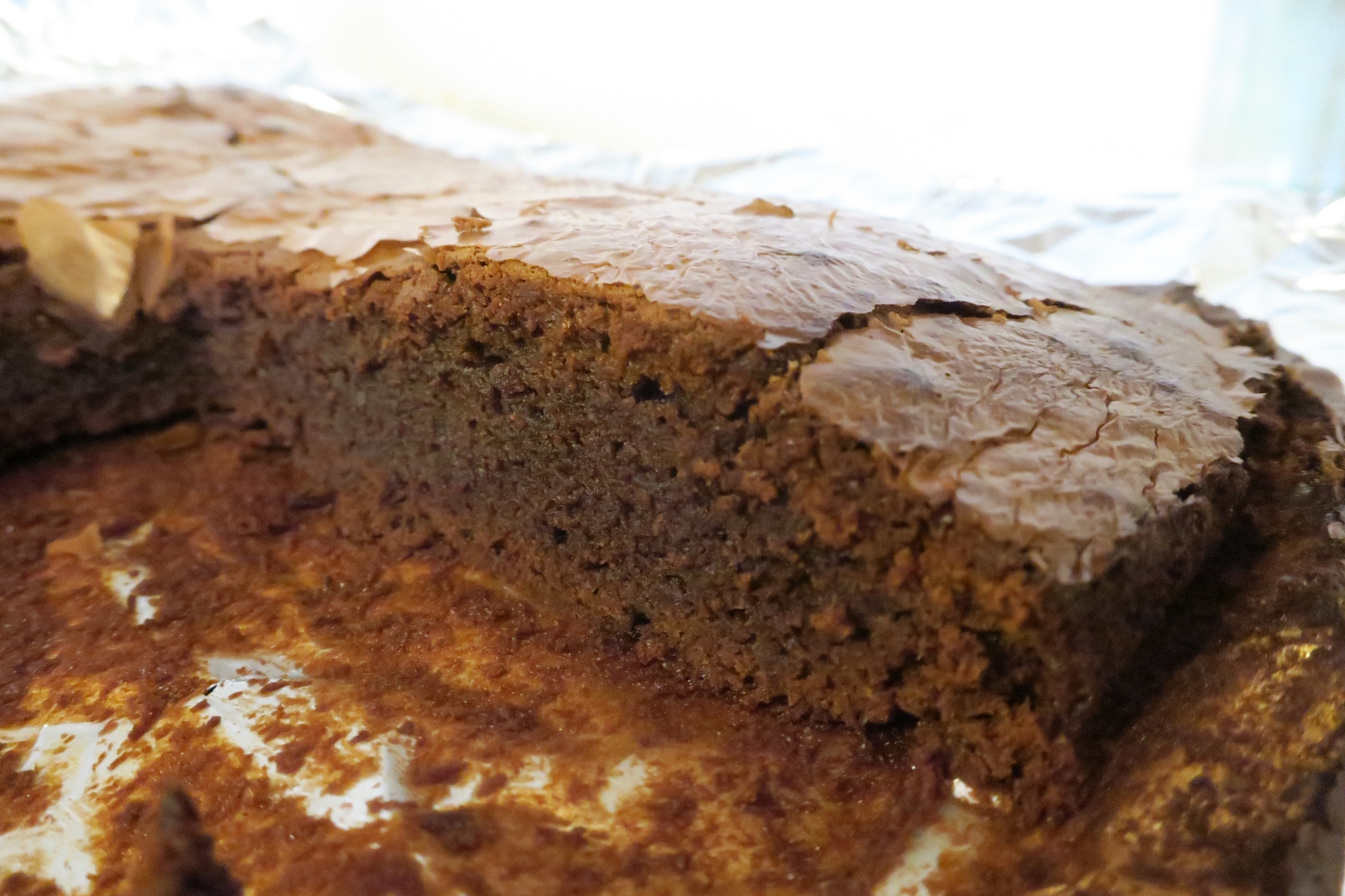
The recipe is the BraveTart recipe on Serious Eats. The only changes I made were to omit the instant coffee and to add an extra egg as the eggs I had to hand were relatively small.
Brave Tart Brownies
Ingredients
- 340g Unsalted butter
- 170g Dark chocolate chips
- 450g Caster sugar
- 55g Soft brown sugar
- 4g Salt
- 7 Eggs
- 1tbsp Vanilla extract
- 125g Plain flour
- 115g Cocoa powder
- Melt the butter in a saucepan over a low heat. Once melted, brown the butter by simmering over a medium heat, stirring continuously, until the hissing stops.*
- Remove from the heat and stir in the chocolate.
- Mix the sugar (both types), salt, eggs and vanilla in a stand mixer on a medium-high setting for ~8 minutes until very thick and fluffy.
- Turn the stand mixer down to low and pour in the chocolate/butter mixture.
- Sift the flour and cocoa powder together. Add to the mixer in one go, then finish the mixing by hand with a spatula.
- Pour the batter into foil-lined pans and bake at 180C for ~30 mins until barely firm.
- Allow to cool in the tin before cutting and removing.
Check out this action shot! This is the finished batter (and it smells amazing!).
Sunday, 24 March 2019
Insomnia bread
Insomnia Bread
Ingredients
- 200g Aage*
- 300ml Water
- 400g Strong wholemeal flour
- 6g Salt
- Mix Aage, 200ml water and 200g flour in a bowl.
- Wrap in a bin bag and leave to rise for ~8.5hrs.
- Add the remaining 200g flour and 100ml water, and the salt.
- Knead in the stand mixer with a dough hook until the dough comes together and stops sticking to the sides.
- Knead briefly by hand**, return to the mixing bowl and rewrap in the bin bag.
- Leave to prove in a warm place for ~3.5hrs.
- Place a Dutch oven*** in the oven and preheat to 220C (as hot as the oven allows).
- Transfer the dough to the Dutch oven, sprinkle with water and close up.
- Turn the oven down to 180C and bake for ~25mins.
- Uncover and bake for a further ~10 mins.
This one tasted absolutely lovely - just the right amount of sourness - but the texture wasn't quite right. I had noticed that the dough was a bit overly wet (I think I was being a bit overly optimistic on hydration levels this time around), but I failed to account for it in the bake. As a result, it was really rather doughy in the middle - it could really have done with much longer in the oven uncovered to help dry it out - but not unpleasantly so. Not a perfect loaf, but still pretty darned tasty!
Friday, 11 January 2019
More cinnamon
Sunday, 18 November 2018
Verdict: Skolebrød and Macarons
But the good: The cardamom tastes great, and even though it's dense and uncooked in the middle, it's still actually quite nice (particularly warm, straight from the oven). The coconut works well, and they are very pretty. And having just trashed the custard so much, dipping them in the leftover custard actually worked pretty nicely. All in all, I think skolebrød deserves another go at some point - but what I've essentially made this time around is some weird pulla with a disappointing filling.
On to the macarons. They're really not bad at all! Essentially all that's wrong with them is that they're a little overcooked (and burnt in places), but they've got the core essence of almondy goodness, that lovely crisp, crunchy exterior and a hint of chewiness on the inside. But then I was following a recipe from the Bible, so what would you expect! One day I will not wuss out and try doing macarons again in an effort to make beautiful, perfect pillowy macarons with feet, but that may not be for a very, VERY long time - until that time though, these will do nicely!
It's a double header!
Skolebrød
Ingredients
For the dough
- 2 level tsp Cardamom pods
- 650g Strong white flour
- 2 sachets Dried yeast
- 1tsp Salt
- 160g Caster sugar
- 80g Butter
- 300ml Milk
- 125ml Water
- 2 Egg yolks
- 60g Caster sugar
- 1tsp Vanilla extract
- 175ml Double cream
- 75ml Milk
- ~2tsp Cornflour
- Icing sugar
- Water
- Desiccated coconut
- Shell the cardamom and grind the seeds using a pestle and mortar.
- Mix the cardamom, flour, yeast and salt together in a large mixing bowl.
- Place the sugar, butter, milk and water in a pan and heat gently until the sugar is dissolved, butter is melted and the mixture is warm.
- Add to the dry ingredients and form a dough. Knead the dough until smooth(er).
- Return the dough to the mixing bowl and wrap in a bin bag. Leave to rise for an hour.
- Knead the dough again and divide into 12 pieces. Roll each piece into a ball and leave to prove, covered.
- Make the custard. Whisk the egg yolks, sugar and vanilla extract together.
- Heat the cream and milk together, then pour slowly into the egg yolk mixture while whisking continuously.
- Return the custard to a low heat and whisk in cornflour as needed to thicken the mixture slightly.
- Poke a well into the centre of each ball of dough and fill with custard.
- Bake at 200C for 30 mins.
- Mix some icing sugar with a little cold water to make a loose icing and brush onto the bread, then sprinkle with desiccated coconut.
There's something really pleasing about dough that's been portioned out into small balls. I don't know what it is, but it's definitely pleasing. These are the individual dough balls just before proving.
Unfortunately, this is after leaving them to prove for about 1hr30. I read somewhere that the final rise is called proofing, because you are proving that the yeast is active. This sounds like a made up fact to me, but I think in this case, I've actually proved that the yeast I used (last two sachets in quite an old pack) was dead. These might be a bit dense...
Forming decent sized wells is harder than you might think. I guess the lack of rise might have made this harder, but you're also fighting the elasticity of the dough. This is the best that I could do...
Which meant that there's a pathetic amount of custard in each skolebrød. I used about 1/4 of the custard that I made, though I also harbour deep, deep suspicions about the custard recipe.
They don't look bad out of the oven!
I really should not have followed the recipe quite so closely. You need the icing to be moist for the coconut to stick, so you should probably sprinkle each one with coconut as soon as it's been brushed with the icing - I brushed all of them with icing first, and by the time I was done, so much moisture had dried/been absorbed that I couldn't really get the coconut to stick very well.
Looks (and smells) gorgeous!
But minor disaster! It's raw around the custard well. It's still edible, but defintitely needed longer in the oven. I wonder if I should have made sure that the custard was piping hot before pouring it in to the skolebrød - that might have helped.
In an effort to save matters, I put them back in a low oven (~150C) for as long as I dared, given that it was already iced. It definitely helped - still distinctly undercooked in the middle, but at least now it's undercooked rather than completely raw!
Macarons
Ingredients
- 110g Ground almonds
- 170g Caster sugar
- 1tsp Plain flour
- 2 Egg whites
- 2 drops Vanilla extract
- Whole blanched almonds
- Mix the almonds, sugar and flour together in a mixing bowl.
- Add the egg whites and vanilla extract, then beat thoroughly.
- Leave to stand for 5 minutes.
- Beat well for a further minute.
- Spoon onto trays lined with baking paper and top with a blanched almond.
- Bake at 180C for 20 minutes.
- Leave to cool on a wire rack.